The cockpit that stays quiet.
A cycling cockpit for the city commuter: rear radar, navigation, no phone.
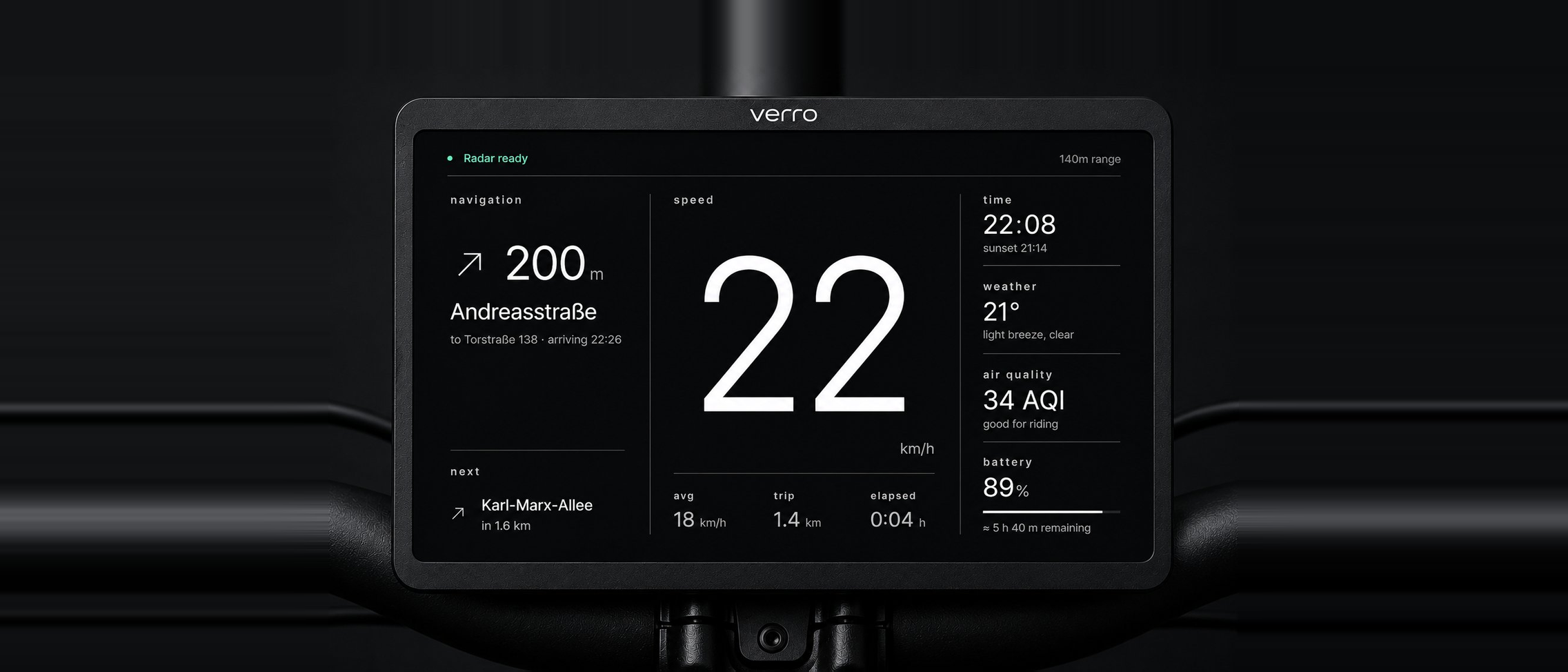
Overview
Verro is a self-initiated concept: a cycling cockpit for the urban commuter, built around a rear radar and a glanceable display. It came out of commuting in Berlin. Bike computers already exist, but they're made for sport cyclists chasing power and heart rate, not for someone crossing a city on stop-start lanes.
The concept is built around that commute: rear awareness without turning your head, navigation without reaching for a phone, and an interface that stays calm until a real threat is closing.
The Problem
Berlin cycling infrastructure is everywhere and barely keeps up. The lanes are tight, pressed against moving traffic, and constantly interrupted by construction. The crashes and near-misses mostly happen at intersections: a car turning across a cyclist's path, two people misjudging the same gap.
The numbers point the same way. Cyclist deaths in Germany have risen even as overall road deaths fell, and a large share of urban collisions happen at junctions where turning vehicles and cyclists meet. Most are ruled the driver's fault.
The tools meant to help mostly miss this rider. Rear radar exists, but only in sport-cyclist products built for the open road. Commuter bike computers exist, but ignore safety. Verro looks at the city commuter and at the moments where things go wrong: lane endings, intersections, a vehicle closing from behind.
Outcome
Verro is a concept, not a shipped product. No rider tested the alert hierarchy on a real road, and the display has never been glanced at in motion. Both of those would break assumptions that look solid on a screen.
The strongest parts came from fixing the constraints early. Deciding what color means, what each threat state says, and what the display can show in under a second made every downstream screen decision easier. The hard calls were made before any pixels.
The weakest part is the lane-switching logic. Suppressing vehicle alerts in protected lanes and re-engaging in mixed traffic is defined in principle but never validated. Whether a rider would trust that behaviour, or learn to ignore it, is a question this project can't answer.
The next step would be getting a rough prototype in front of real commuters. Not to test the UI, but to find out which alert they'd turn off first.